
Mar 9, 2026
Introduction
When we watch an aircraft accelerating down the runway and climbing into the vast sky, it feels like a miracle. We may wonder how a machine that weighs tons lifts off the ground and travels thousands of miles across the continent. Behind this miraculous event lies one of the greatest engineering innovations, the jet engine.
Jet engines are the heart of modern aviation. They power most modern day commercial aircraft , military fighters, and cargo aircrafts. Though the concept of this marvelous machine appears to be complex, the fundamental idea behind the jet propulsion is actually based on a very simple law of physics.
General Preview of Jet Engine
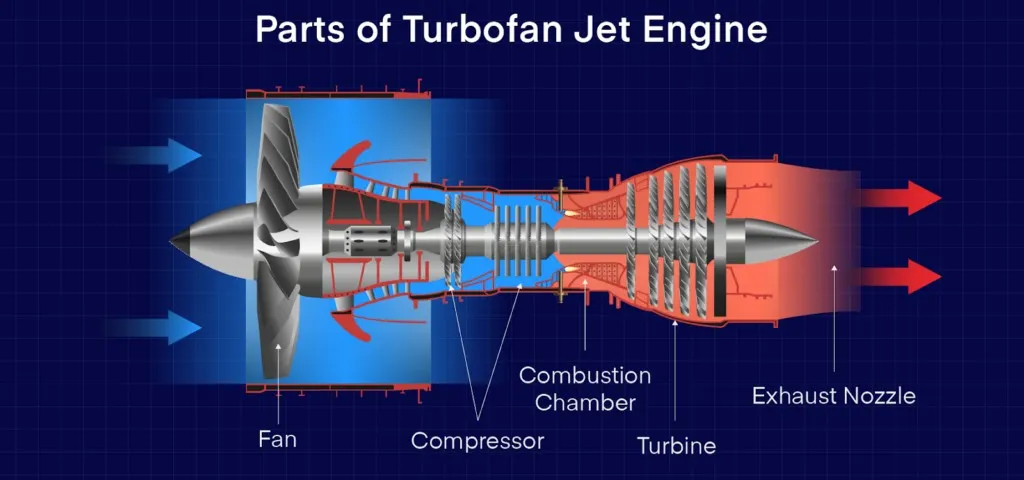
The modern jet engine is a precisely designed continuous-flow gas turbine system designed to accelerate air and convert fuel energy to thrust . As the air passes, it goes through several stages. The major stages of a jet engine are: Fan, Compressor, Combustion chamber, Turbine, and Exhaust Nozzle.
The Fan
Fan is one of the most recognizable features of a turbofan jet engine. The fan consists of large rotating blades to move a massive amount of air. The fan is normally driven by the turbine in the core, but at the initial stage, the fan is started on with the power from Auxiliary Power Unit(APU) which than rotates the turbine and the turbine then rotates the fan. The fan, when rotating, draws air inside the engine and accelerates its rearward. The air driven inside the engine is divided into two separate streams:
- Core airflow, the airflow that enters the core of the engine and goes through stages like compression and combustion
- Bypass airflow, the airflow which does not enter the engine core and flows through the bypass duct, a passage for airflow on the outer side of engine core.
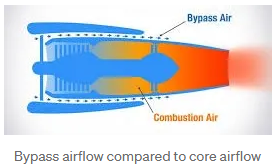
The bypass air produces a large amount of thrust in aircrafts. Because it moves a huge amount of air, roughly 80% of air in civil aircrafts, at a relatively low velocity, which is more efficient than moving a small amount of air at high speed. This high mass and low velocity creates a massive thrust while reducing noise and improving fuel efficiency in aircrafts. Modern turbofan engines such as the GE90 and Rolls-Royce Trent series can produce more than 90,000 pounds of thrust and power aircraft like the Boeing 777.
Compressor
Air that is entering the engine core through the fan enters the compressor. The compressor consists of two main parts: the rotor and the stator. Rotors are multiple stages of rotating blades followed by stators, the stationary blades. The rotors when they spin accelerate the air and the stators redirect and guide the airflow so that it can be compressed efficiently. In the compressor, the air become denser and pressure increases with each step. The compressor has two stages: Low pressure compressor(LPC) and High pressure compressor(HPC). LPC is the initial stage that raises pressure moderately, often part of turbo fan. HPC further compresses the air to extreme pressure before it enters the combustor.
Combustion Chamber
After compression, the compressed air enters the combustion chamber. Inside this chamber, fuel is sprayed into the compressed air and ignited in the presence of atmospheric oxygen. The reaction occurring in the combustion chamber is given below:

The combustion in a jet engine occurs as a continuous and controlled flame. The burning fuel creates a larges amount of thermal energy and the temperature in the combustion chamber often exceeds 1500 degrees Celsius.
Turbine
The high temperature gas produced by the combustion chamber expands rapidly and moves through the turbine. The turbine consists of rows of blades that extracts energy from fast moving gas. As the gas passes over the turbine blade, the blades rotate. This rotation drives the central shaft which is connected to the compressor and fan located at the front of the engine. This way, turbine provide mechanical power to drive the compressor and fan. The fan and the turbine, connected through the shaft, move at the same speed. But in modern jet engines, the speed is adjusted according to requirement with the help of gearbox control system. Although the turbine extracts energy from the flow of gas, the gases still retain significant energy as they continue toward the exhaust nozzle.
The Shaft System
The shaft is the mechanical link that connects the turbine to the compressor and fan. The main function of the shaft system is to transmit torque from the turbine to the compressor. This allows different sections of the engine to rotate at different speeds. It connects the rotating parts, specifically linking the turbine stage to the compressor stage. The shaft system has two parts: low pressure shaft and high pressure shaft. Low pressure shaft is usually connected with the turbine blades and the compressor blades, high pressure shaft is connected with the high pressure compressor and high pressure turbine. Power is driven from the high pressure shaft. Modern engines use a multi-spool design where the shafts are nested(one inside the other) to allow different compressor/turbine sets to rotate at their optimal speed. This configuration improves efficiency and stability.
Exhaust Nozzle
After the gas passes through the turbine, the gases still contain substantial kinetic energy. These gases exit the engine through the exhaust nozzle, which accelerates them to extremely high velocity. The nozzle is designed precisely to transform the remaining energy in those gases into motion. As these gases are expelled backward, an equal and opposite force pushes the aircraft forward. This force is know as thrust.
The Physics Behind Jet Engine Propulsion
The operation of a jet engine is explained by Newton’s Third Law of Motion, which states that for every action, there is an equal and opposite reaction. When the exhaust pushes the gases at a high velocity in backward direction, its reaction pushes the aircraft body in the forward direction.
In simplified form, thrust can be described using the momentum equation:
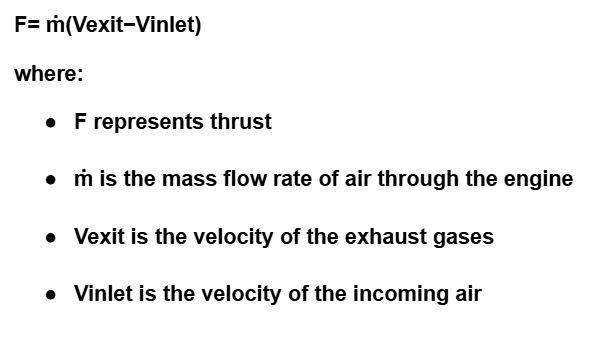
The greater the increase in air velocity, the more thrust is generated.
The Brayton Cycle
The thermodynamic process that governs the jet engine function is the Brayton Cycle. The cycle consists of four major stages:
- Compression of incoming air
- Combustion of fuel at high pressure
- Expansion of hot gases through turbine
- Exhaust of gases through the nozzle.
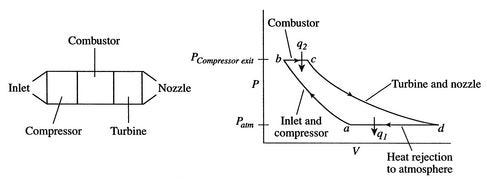
During the cycle, chemical energy stored in fuel is converted into thermal energy and then this thermal energy is transformed into kinetic and mechanical energy.
Brayton Cycle is the fundamental thermodynamic process used in gas turbine engine including aircraft jet engines.
Conclusion
Jet engines represent one of the most magnificent achievements in modern engineering. By carefully controlling airflow, compression, combustion, and expansion, these machines convert chemical energy stored in fuel into the powerful thrust required for flight.
Understanding how jet work reveals the complex interplay of physics and engineering that allows the aircraft to fly across the globe. Every time an aircraft flies into the sky, it demonstrate remarkable capabilities of human innovation and scientific understanding.
Tags:
About the Author

Comments
4 responses to “How Jet Engines Work: Understanding Turbofan Engines and Modern Aircraft Propulsion”
-
Informative content. Keep it up.
-
Thank you. Stay with us.
-
-
Nice work, it was needed
-
Beginner friendly for those who doesn’t know anything about the mechanic of jet.


Leave a Reply